A PlainStripes Letter
—
The spreadsheet was immaculate.
Eighteen months of operating expenses — liquid, untouched, sitting in a high-yield savings account, growing at 4.7%. Revenue trending up. Receivables clean. Every line item categorized, color-coded with a spectrum of greens. This founder had built exactly the business every personal finance book had ever told her to build.
She slid the laptop our way, awaiting our feedback.
We reviewed the financials. We reviewed the founder. We then reviewed the financials again. Before finally looking the founder in the eye and telling her something she had never expected to hear: “You’ve been extraordinarily disciplined. And it’s costing you.”
The room fell silent, that particular kind of silence that occurs when an uncomfortable truth emerges.
At PlainStripes, we’ve come to observe that the same kind of discipline that helps a founder succeed early on has the tendency to quietly limit that founder’s potential later on.
—
The Silo Problem
There’s a kind of winter that descends upon the northern prairies, wherein the farmer’s entire harvest rests safely inside the grain silo, untouched by the frost, unscathed by the cold. Nothing can ever touch it, nothing can ever take it, and nothing can ever grow from it.
This, friends, is the Silo Problem: capital that has been impeccably protected, yet utterly idle.
The people we work with, the people we interact with, are not careless people. They are, in fact, the opposite: careful, measured, people who have been taught by a lifetime of uncertainty to believe in liquidity as the only real capital base.
They learned, correctly, to believe in liquidity.
They learned, correctly, to believe in liquidity because they saw what happened to people who did not believe in liquidity in 2008.
They saw what happened to businesses in 2020 because of a lack of capital.
But what happens to capital, left idle, is not what people expect.
What happens to idle capital is that it decreases. It decreases quietly, behind the scenes, with the patience of a geologic era.
At 3% inflation, a static $500,000 capital base loses $15,000 in purchasing power every year, not in a spectacular, apocalyptic fashion, but on a normal Tuesday afternoon, a day in which absolutely nothing out of the ordinary happens.
The capital base doesn’t announce, “Hey, I lost $15,000 in value!” It simply becomes less.
The saver has preserved his grain.
The grain has simply begun to rot.
—
What We Mean by “Thriving Investor”
We want to make clear what we mean by “investor,” because the word has a lot of connotations: trading screens, Bloomberg terminals, a guy in Greenwich, Connecticut, running a book.
We are not talking about that.
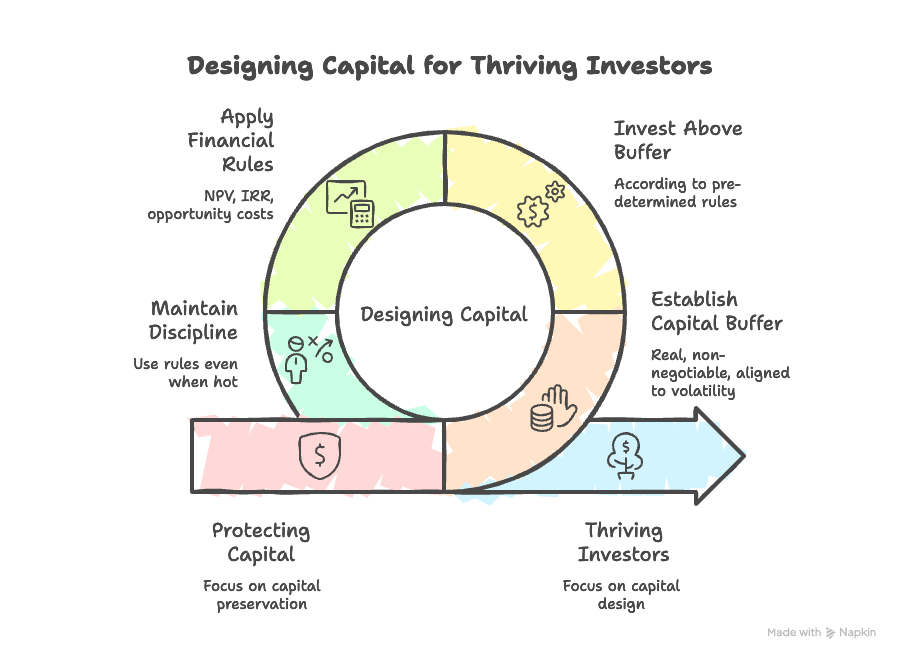
When we talk about thriving investors, we are talking about people who have made a fundamental shift in their approach to capital: from a focus on protecting capital to a focus on designing capital.
The difference between the two may feel small, but it is not.
A thriving investor has a capital buffer, a buffer that is real, non-negotiable, and aligned to the actual volatility of their business.
They then invest all of the capital above the buffer according to a set of rules, rules determined in advance, in calm, in a state of quiet before any particular decision must be made.
For example, questions like: Does this project return our hurdle rate within 12 to 18 months? Or: Is this hire funded by incremental revenue it generates, or by existing margin? Or: Does this equipment save us more in cost than it costs us to own it for a given period of time?
In finance textbooks, it’s called net present value (NPV), internal rate of return (IRR), and opportunity costs. The problem is, most operators don’t think in terms of formulas. They think in terms of feelings: safety, fear, and regret. To be a successful investor, you don’t need to be able to recite more formulas. You need to be an operator who thinks in terms of a few rules you can use.
The rules aren’t complicated. The discipline required to use them, even when it feels good, even when it’s hot, and even when the competition just did something, that’s what it takes.
—
The PlainStripes Three-Bucket Operating System
We want to make clear what we mean by “investor,” because the word has a lot of connotations: trading screens, Bloomberg terminals, a guy in Greenwich, Connecticut, running a book.
We are not talking about that.
When we talk about thriving investors, we are talking about people who have made a fundamental shift in their approach to capital: from a focus on protecting capital to a focus on designing capital.
The difference between the two may feel small, but it is not.
A thriving investor has a capital buffer, a buffer that is real, non-negotiable, and aligned to the actual volatility of their business.
They then invest all of the capital above the buffer according to a set of rules, rules determined in advance, in calm, in a state of quiet before any particular decision must be made.
For example, questions like: Does this project return our hurdle rate within 12 to 18 months? Or: Is this hire funded by incremental revenue it generates, or by existing margin? Or: Does this equipment save us more in cost than it costs us to own it for a given period of time?
In finance textbooks, it’s called net present value (NPV), internal rate of return (IRR), and opportunity costs. The problem is, most operators don’t think in terms of formulas. They think in terms of feelings: safety, fear, and regret. To be a successful investor, you don’t need to be able to recite more formulas. You need to be an operator who thinks in terms of a few rules you can use.
The rules aren’t complicated. The discipline required to use them, even when it feels good, even when it’s hot, and even when the competition just did something, that’s what it takes.
—
What It Looks Like When It Works
The founder we told you about at the beginning. The one with the immaculate spreadsheet. Came back to us six months later.
We’d worked through her allocation. Moved $200K of her $480K cash reserve into Bucket Two. Two hiring decisions she’d been putting off because they’d been too expensive. Moved $100K into Bucket Three. Indexed. Automatic. Policy-driven. Left $180K. A little more than four months of her real expenses.
Six months into her new job, one of those new team members had already generated incremental revenue. The other was just three weeks away from her first direct close. The allocation of the market had shifted in ways she hadn’t anticipated. And the number she kept going back to wasn’t any of those. It was this: she wasn’t waking up at 3 a.m. wondering if she had made the wrong decision.
Not because the risk wasn’t real. Not because the decisions didn’t have consequences. But because the process of decision-making had some structure.
When you build the framework before the pressure is on, you stop wondering if you’re making the wrong allocation every time you have to make one. The stress wasn’t about having too few answers. It was about having no process.
—
The Question Worth Sitting With
There is a moment in most of the client relationships we value the most—usually in the second or third serious conversation—when the operator stops presenting their numbers and starts asking another kind of question.
Not “How do I protect this?”
But “What should this be doing?”
That’s the shift. From saver to thriving investor. From grain in the silo to a field waiting to be planted. It’s not a dramatic shift. It’s a recalibration. A recalibration that, from our experience, doesn’t come from a market event, a windfall, or a stroke of luck. It’s a recalibration that comes from a conversation where the individual finally understands the true cost of idle discipline.
If this resonates with you, if this sounds like something you struggle with, good cash reserves, no real plan to deploy those reserves, making investment decisions based on instinct rather than rules… this is exactly the work we do with clients at PlainStripes.
Modeling your actual numbers. Building your 3 buckets. Writing your investment decision framework even though you don’t “need” to.
If this resonates with you, if you want to move from a disciplined saver to a thriving investor, we invite you to take the first step. Take a look at your current cash reserves through the lens of the 3B-OS. Identify the silos. We’ll be here when you’re ready to turn those silos into systems.
—
— The PlainStripes Team
PlainStripes provides financial operations and cash flow strategy to founders and professionals. This letter is intended for informational purposes only and should not be considered investment advice.