A PlainStripes Letter on Markets, Behavior, and Why This Machine Matters to Operators
—
You’re in a co-working space. CNBC is on TV. Red and green numbers are flashing, and someone is talking very quickly about the Fed. There’s also a ticker running along the bottom of the screen, like the nervous system of the financial world.
You glance up at the TV for three seconds, then go back to your spreadsheet.
That’s for traders. I have a real business.
You’re absolutely right. Those three seconds don’t matter. But you’re wrong about the rest. You think the stock market is just something traders waste time on. It’s not. It’s the coordination mechanism that turns trillions of savings, opinions, and emotions into a single set of prices, which quietly determines the funding of your business, the value of your equity, and ultimately, what the world thinks of what you built.
That’s worth understanding. Not obsessing over. Understanding.
I. What the Machine Actually Is
The stock market is two markets. There’s the primary market, where companies raise money. They issue shares, get investors, and get a public price assigned to their equity. And then there’s the secondary market, where investors buy and sell those shares with each other. The company doesn’t get any of those shares. But the price assigned to those shares? That matters.
But here is the layer that most introductions gloss over: the markets as a computation. Every trade represents someone’s belief about the future cash flows. The purchase represents a belief that the future cash flows will be worth more than the current price. The sale represents the opposite. Millions of these computations per day go into a price that becomes the basis for the entire system.
The S&P 500 isn’t the market going up. It’s the aggregate of millions of people updating their beliefs about the future cash flows of five hundred businesses. It’s a continuous, real-time opinion poll on the future of the economy.
That’s the machine. It’s not a casino. It’s a coordination system.
—
II. The Three Problems It Solves
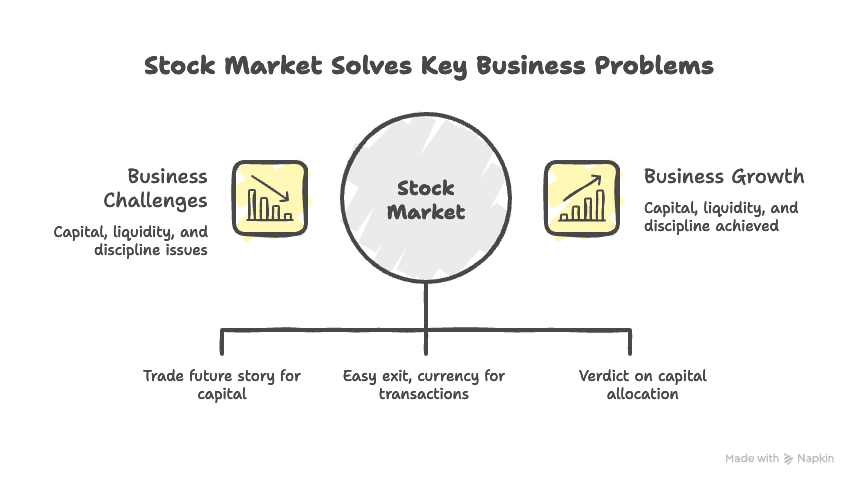
Capital Formation. The stock market allows a company to take a story about the future and trade it for capital today at scale, from strangers, without giving up control to anyone. The price it gets represents the cost of equity: the rate at which all projects must be evaluated to have a material impact on the business. That’s why a SaaS company growing at 40% and making 20x revenue is the same price as a distributor growing at 1% and making 1x revenue. The stock market isn’t crazy. It’s just applying different cost of capital based on its own compounding potential.
Liquidity and Optionality. Why do people accept lower expected returns on publicly traded companies versus private companies? It’s because they can exit without going through a six-month process. It’s also why the stock market works as a currency: to buy companies, to keep employees happy anywhere in the world, and ultimately for your own balance sheet that you’ve been putting off.
Price Discovery and Discipline. Public company stock prices, over time, are a verdict on the allocation of capital. A company whose profits are below its cost of equity will experience a declining multiple, increasing cost of new capital, and an increasingly uneasy board. There is no analogue in non-public companies. It is a mechanism that links the boardroom and the ultimate cost of future boardroom decisions. It is frequently wrong in the short term. It is unforgiving in the long term.
—
III. Why It Doesn’t Look Rational Up Close
The conventional wisdom holds that the price of a stock reflects the present value of future cash flows, discounted at an appropriate discount rate. It is correct. It is wrong in almost all cases. It is wrong because stock prices are not determined by formulas; they are determined by people, people who are motivated by fear, greed, and conformity. Behavioral finance has demonstrated the consequences of these forces:
– Loss aversion: the pain of losses exceeds the pleasure of gains, so people tend to hold on to losers and cut winners.
– Herding: new money flows are the result of price movements, not the cause. Momentum is an emotional response, not an intellectual one.
– Over- and under-reaction: markets overreact to extreme news, underreact to subtle news.
This is not an irrational market. It is not a rational market. It is something else: efficient, but only approximately, over time; systematically biased, but only over short time periods. It is a voting machine in the short term, a weighing machine in the long term, and a mirror in the time in between. And understanding that is worth more than any prediction.
—
IV. How This Shows Up in an Operator’s Life
On a Tuesday morning, you are not thinking about the stock market. You are thinking about a contract renewal date three weeks away, the site manager who handed in his notice, and the fuel costs this quarter to make sure you get the margin you have promised yourself you will get.
The stock market is not on your mind. And that is the problem.
You feel the market in three ways. And by the time you feel it, someone else has already made the decision.
You feel it one place as your exit. Your buyer, whomever they are, whenever they are starting a spreadsheet before they even think about your financials. And the multiple they use to calculate your financials comes directly from what the market is paying for similar businesses right now. You have not opted into this system. You have not opted out of it. Two operators have the same kind of service business. Same revenue. Same margin. Same customer base. One of them sold his business in Q1 2022. The other one sold his business in Q4 2022. The difference in the sale price was not operational. It was timing they could not control. It was a market they were not thinking about.
Second, the person you are about to lose. You made a promise to them: phantom equity, a share of the profits, a handshake about what a share of this thing might one day be worth. You meant it. They believed you. And deep down, they have been calculating what you promised them ever since not literally, not on a spreadsheet. But when they read about deals getting done in the industry, when they see what similar businesses are trading for, when the winds shift and the perceived value of what you promised them slowly starts to decline well, they are resigned to their fate before they even know it.
Third, the one no one wants to talk about candidly. You have spent fifteen years building something real. You have employees, you have customers, you have cash flow. And at some point along the way, without anyone ever telling you so, it became your pension, your safety net, your retirement plan, and your entire net worth all wrapped up into one package that you can’t sell on a Tuesday. No financial advisor would ever recommend such a concentration of risk to anyone except to call it an emergency.
—
V. How PlainStripes Designs Around It
The Three Bucket Operating System was designed because of the operator above—not the operator who goes public, but the operator who has twelve vans, two anchor accounts, and everything on the line.
Bucket One—Stability has no market risk. Six months of salary is the rule of thumb for a salaried employee. Six months of salary is not the rule of thumb for an operator whose salary is housed within the same entity as their risk. The business has a bad quarter; the salary does not hold. The contract does not perform; the salary does not hold. Bucket One is what holds. Volatility is not a tradeoff for an operator; volatility is not permitted.
Bucket Two—Strategic Growth takes market prices and turns them into operating intelligence. When multipliers are rising in your industry, that tells you something: that means that capital is cheap and demand is strong, invest in the business. When they are falling, it tells you something else. You don’t need to monitor the ticker every day of your life. You need to monitor the thermometer once a quarter, and you need to monitor how hard you’re pressing on the accelerator. Most operators are already doing this intuitively. The difference is doing it intentionally, using a number, before the market forces you to do it.
Bucket Three—Long Term Wealth is the counterbalance, and for an SME owner, it is not optional, not aspirational, not something you do later. Your business is already doing the job of Bucket One, and your business is already doing the job of Bucket Two. Your business is illiquid. Your business is operationally dependent on you showing up every day. Your business cannot be rebalanced. Your business cannot be trimmed if you have a bad day. Bucket Three is the only part of your financial life that compounds without your participation, that compounds without your input, that continues to work for you even if you get sick. Every year that it doesn’t exist is a year of compounding that you’re not going to get back.
Three principles govern it:
– Broad exposure over stock picking. You do not have to be right on individual securities. You just have to be in the market long enough for the market to work. The data on index-based compounding over twenty-year time frames is quite strong. The data on consistent after-fee alpha in active security selection is not.
– Drawdowns are accepted; design for sleep. Bucket Three will decline by thirty percent at some point. This is not a risk that needs to be managed. It is a requirement that needs to be designed for. The question is whether or not that decline, when it occurs, causes a mistake in one of the other buckets: a panic sale, a liquidity event, a decision made in a moment of stress that undermines all the work that has gone into the previous years of patience. Design is before drawdown. It is not after.
– Compounding tool, not scoreboard. The person whose job it is to check Bucket Three against the index every morning is not investing. He or she is creating noise that affects every other decision that person will make that day. Set it. Leave it. Let it do the one thing your business, for all its greatness, cannot do without you.
The Real Answer to “What’s the Big Deal?”
The big deal isn’t that the stock market goes up over time – although, as an aside, it does.
The big deal is that it is the official record of what the world currently believes about the future of businesses. It is the price at which risk is set, and stories are funded. It is the invisible force that affects operators in terms of valuation, talent, and wealth in ways that don’t require your permission.
The work we do at PlainStripes is to make sure you understand this well enough to do three things:
Not be intimidated by it.
Not be reckless with it.
And not be oblivious to it when it starts pricing the very thing you’ve spent your life creating.
—
This letter is part of an ongoing series on capital, behavior, and operating with clarity. The previous letter explained the Three Bucket Operating System. The next letter will dig deeper on Bucket Three and how to create a compounding machine that works while you are busy operating the business.