Category: Articles
Knowledge Resources
Guides, breakdowns, and short-form videos covering the financial topics every founder should understand

— You walked in prepared. The business is real and the revenue is real. You weren’t asking for a bet; you are asking for the capital to fulfill a contract already on the table. You brought the documents. You answered everything they asked. You left feeling like the conversation had gone the way it was […]
The Ideal Business Borrower: Winning Over a Lender’s Trust
- August 21, 2026
- 4 min read
---
You walked in prepared.
The business is real and the revenue is real. You weren't asking for a bet; you are asking for the capital to fulfill a contract already on the table. You brought the documents. You answered everything they asked. You left feeling like the conversation had gone the way it was supposed to.
Then the call came.
Not approved. No clear explanation. Just the particular, practiced kindness of a "no" that was never going to be a "yes" and you on the other end of the phone, trying to understand what you missed.
Here's what most people don't know: lenders aren't just evaluating your business. They're evaluating you as a borrower. And the borrower who wins isn't always the one with the strongest numbers. It's the one who walks in speaking the lender's language.
This is that language.
---
What a Lender Is Actually Asking
Every question in that meeting about your revenue, your debts, and your projections is a variation of the same three questions:
Can you repay this? Will you repay this? What happens if something goes wrong?
That's it. The entire evaluation. All the paperwork, all the ratios, all the scrutiny lives inside those three questions. The borrower who answers them clearly, with evidence, before being asked—that's the borrower who leaves with a term sheet.
---
The Five Things Lenders Read Before You Say a Word
1. Your Credit Profile Both personal and business. Your personal score signals character specifically, whether you honour financial commitments when no one is enforcing them. A score above 720 opens doors. Below 650, the conversation shifts before you've introduced yourself.
2. Cash Flow Not Profit Profit is an accounting number. Cash flow is reality. Lenders want to see that money actually moves through your business consistently so that after expenses, there is enough left to service a debt without a crisis. A business can be profitable and still fail a cash flow review.
3. Debt Service Coverage Ratio (DSCR) This is the number that tells a lender whether you can actually afford the loan:
DSCR = Annual Net Operating Income ÷ Annual Debt Payments
A DSCR of 1.0 means you break exactly even. Lenders want 1.25 or above, meaning for every dollar of debt payment, you're generating $1.25 in income. Below that, the risk conversation changes entirely.
4. Time in Business: Under two years and most traditional lenders grow cautious. Not because young businesses are bad, but because they don't yet have the track record that replaces uncertainty with evidence.
5. The Story Behind the Numbers This one doesn't appear in any form. It's the coherence between what your documents show and what you say in the room. Lenders have heard every version of every explanation. What they're listening for is whether your story and your numbers are the same story.
---
Here’s an example
Marcus runs a four-year-old landscaping company. Revenue was a solid $340,000 last year. He applies for a $60,000 equipment loan but the bank declines.
He's confused. The business is real. The revenue is real.
What the lender saw: a DSCR of 1.08, barely above break-even after debt payments. A personal credit score of 661 from a period three years ago when a supplier dispute went to collections. And financials that showed strong revenue but inconsistent monthly cash flow: three strong months, one very thin one, every quarter.
Marcus wasn't a bad borrower. He was an unreadable one. The lender couldn't clearly answer all three questions. When the answer isn't clear, the answer is no.
---
The Borrower Who Gets the Yes
The ideal borrower doesn't have a perfect business. They have a legible one.
Legible means a lender can look at your documents, ask you a few questions, and come away with a clear, confident answer to all three. Can they repay? Yes, here's the cash flow. Will they? Yes, here's the credit history. What if something goes wrong? Here's the collateral, here's the reserve, here's the contingency.
What separates a legible borrower?
- Clean, current financial profit and loss, balance sheet, and cash flow statement for the last two to three years. Not approximate. Not estimated. Prepared.
- A specific loan purpose, "I need capital" is not a purpose. "I need $45,000 to purchase the CNC machine that fulfills the manufacturing contract attached to this application" is a purpose. Specificity signals control.
- A repayment narrative before they ask, you explain exactly how the loan gets repaid. Which revenue stream? Which timeline? What the monthly payment represents as a percentage of operating income.
- Addressed weaknesses: If your credit dipped two years ago, explain it before they find it. If revenue had a bad quarter, contextualize it. Lenders don't expect perfection. They expect honesty. A weakness you name is a weakness under control. A weakness they discover is a risk they didn't know you were carrying.
---
Picture this.
Diana runs a catering company; three years in, it has $280,000 annual revenue. She wants $50,000 for a commercial kitchen upgrade that would let her take on corporate contracts she's currently turning away.
She walks in with two years of organized financials. Her DSCR is 1.31. Her personal credit is 714. And before the loan officer asks a single question, she says,
"I want to flag something upfront. Revenue in Q3 last year dropped about 18%; that was the period I lost my largest client. I've since replaced that revenue with three smaller clients, which actually makes the income more stable. I can show you the month-by-month breakdown."
The loan officer wasn't going to ask about Q3 yet. Diana just answered the question before it was a concern.
She gets the loan. Not because her numbers were perfect. Because she walked in as someone who understood her own business clearly enough to explain it, including the part that didn't look great, before being asked.
That's what legibility looks like.
---
Before You Walk In
You cannot control the lender's criteria. You can control how clearly you answer their questions.
Check these before any lending conversation:
✓ Pull your personal credit report know your score and know what's on it before they do
✓ Calculate your DSCR; if it's below 1.25, understand why before you're in the room
✓ Have 2–3 years of clean financials prepared: P&L, balance sheet, cash flow statement
✓ Write one paragraph explaining exactly what the money is for and exactly how it gets repaid
✓ Identify your one weak spot and prepare a clear, honest explanation of it
The lender across the table has seen every version of every application. What they remember that makes them say yes when the numbers are borderline is the borrower who walked in knowing their own business well enough to explain it without being asked.
That borrower is prepared. That borrower is legible.
That borrower is you.
---
What's the one thing you wish you'd known before your first lending conversation? The best responses will be featured in a forthcoming issue alongside our Lender-Readiness Checklist.
Next issue: Ratio Red Flags the numbers quietly ending your loan application before you finish your first sentence.
PlainStripes LLC

PlainStripes LLC – The Capital Brief — You checked the balance. You’ve been contributing to this account for 2 years, not perfectly but consistently. Skipped a couple of months when the business needed it. Doubled up when things were good. You opened the app expecting to feel something. Progress, momentum, the quiet satisfaction of a […]
The Sweet Spot: How Compound Interest Actually Works
- August 21, 2026
- 8 min read
PlainStripes LLC - The Capital Brief
---
You checked the balance.
You've been contributing to this account for 2 years, not perfectly but consistently. Skipped a couple of months when the business needed it. Doubled up when things were good. You opened the app expecting to feel something. Progress, momentum, the quiet satisfaction of a number that reflects the discipline it took to build it.
The number was smaller than you thought it would be.
Not wrong, not a mistake. Just smaller. You did the rough math in your head and realized that after two years of contributions, the account had grown by what felt like almost exactly what you'd put in. No magic, no multiplication, just your money, sitting there being your money.
You put the phone down; somewhere in the back of your mind a thought formed that you didn't quite let yourself finish.
Maybe this isn't working? Here is what's actually happening, it is working.
You just haven't reached the sweet spot yet.
---
The Thing Nobody Shows You on the Graph
When people explain compound interest, they almost always start with the formula, or they show you the famous exponential curve that lines along mostly flat and then at some point bends sharply upward like a hockey stick and keeps climbing.
What they don't tell you is where you are on that curve right now.
In the early years (and this is the part that makes people quit). The line is almost indistinguishable from flat. You are putting money in, and the money is growing, but the growth is so gradual and unimpressive relative to the effort that it feels like nothing is happening.
Something is happening, but it's happening underground, the way roots grow before anything visible appears above the soil. The math is working; you just can't see it yet.
The sweet spot is the part of the curve where compounding stops feeling like patience and starts feeling like momentum is not a reward for waiting; it is what waiting is. The length of time you stay in the ground is what determines how high you eventually grow.
---
What Compound Interest Actually Is (In Plain Terms)
Before you think of any formula, understand this:
Compound interest is interest that earns interest on itself, Simple!
If you have $10,000 earning 8% annually, after year one you have $10,800. It's simple enough, but here's where it changes. In year two, you don't earn 8% on $10,000. You earn 8% on $10,800. The interest you earned last year is now part of the principle. The interest is working also, It is in the field.
By year three, you're earning interest on $11,664. By year 10, without adding another cent, that $10,000 has become more than $21,500, it more than doubled purely through the mathematics of repetition.
The compounding is not doing anything magical; it is just doing the same thing over and over on a number that keeps getting slightly larger. The “magic” is in the duration. Time is not the context in which compounding happens; time is the mechanism.
---
The Rule of 72
If you want to understand compounding intuitively. The number 72 is key.
Here’s how it works: Take your annual interest rate and divide by 72, that's how many years it takes to double your money. Simple!
- At 6% annual return, 72 divided by 6 equals 12 years to double
- At 8% annual return, 72 divided by 8 equals 9 years to double
- At 10% annual return, 72 divided by 10 equals 7.2 years to double
That's useful on its own, but here's what makes it powerful: every time your money doubles, the next doubling starts from a larger number.
Compounding doesn't get faster over time; the doubling period stays the same. What changes is the size of each doubling.
Start with $10,000 @ 10% annual return. The first doubling brings you $20,000, a $10,000 gain. The second brings you $40,000, a $20,000 gain. By the fourth doubling, you're at $160,000, and that single doubling produced $80,000 on its own.
Same rate. Eight times the dollar result. Using the Rule of 72, it will take 7.2 years for your money to double at 10% return. This means it will take 28 years for this investment to get to $160,000. This is the sweet spot. The point where the doubling that has already happened is doing more work per cycle than your original contribution ever could.
This is why the early years feel unremarkable and the later ones feel like something shifted. Nothing shifted; the math was always going to do this. The only variable is whether you stayed long enough to reach the doublings that move the actual number.
---
Picture this
Two friends, call them Nia and David, have the same conversation at 25. A mutual friend has just explained compound interest over dinner, and both of them come away with the same intention: start investing.
Nia starts the following Monday. She sets up an automatic transfer of $300 a month into a low-cost index fund, and critically, she does not touch it. She does this for 10 years, from age 25 to 35, and then stops contributing entirely. Life gets expensive. She leaves the account alone and lets it sit.
David means to start at 25, but the timing never feels right. There is a move, a career change, a year of figuring things out. He starts at 35, with the same $300 a month, and unlike Nia, he keeps going, contributing steadily from 35 all the way to 65, 30 years of contributions. To Nia, at 65, assuming the same average annual return, David, who contributed three times as long, has less than Nia does.
Nia put in $36,000 over 10 years; David put in $108,000 over 30. Nia ends with more. That variable made the difference. It was not effort. It was not discipline. It was not the amount. It was the 10 years Nia started before David did, 10 years in which her money was in the ground, grown roots, before either of them had a grey hair.
---
The Sweet Spot Is a Feeling, Not Just a Number
Here is the part most financial content skips over because it is harder to put in a graph.
The early years of compounding feel unrewarding. This is not a perception problem. This is not a failure of patience or gratitude or financial literacy. It is a real characteristic of exponential growth that it is genuinely, measurably slow at the start. You are not imagining it. The curve really is nearly flat. Your effort really does exceed your visible results.
What you are doing in those flat years is not waiting. You are building the base that determines everything that happens later. Every dollar you add in year three is worth exponentially more than a dollar added in year 20, not because the interest rate is different but because the time left for that dollar to compound is longer. You are buying time, and time in this equation is the one asset that cannot be purchased later at any price.
The feeling of the sweet spot, when the growth becomes visible, when the account number starts to move in ways that feel disproportionate to what you put in, is not the moment compounding starts working. It is the moment it becomes impossible to ignore. It was working the whole time.
Picture this:
Elena is 41. She started an investment account at 32 and has contributed consistently for 9 years. She checks her balance most months, adds what she can, and does not spend much time thinking about it.
Then, one Tuesday (nothing special about the Tuesday), she opens the app and notices something. In the past 12 months, her account has grown by more than she contributed in her entire second year of investing. She checks again. She does the math. She checks a third time.
It has not grown because she contributed more this year. It has grown because the base has finally become large enough that 7% of it is a significant number. The interest she has been quietly earning for 9 years has been accumulating underneath the surface. Now, without any change in her behaviour, without any additional effort, the curve is starting to bend.
She sits with that for a moment, and then she calls her younger sister, who keeps saying she will start once things settle down, and she says, "I need you to hear something."
---
The Other Side of the Curve: When Compounding Works Against You
Everything that makes compound interest extraordinary when it's working for you makes it punishing when it's working against you.
Everything that makes compound interest extraordinary when it's working for you makes it punishing when it's working against you.
A credit card at 22% annual interest, carrying a $5,000 balance:
- After year one: $6,100 owed
- After year three: $9,100 owed
- After year five: more than $13,600 owed
You haven't borrowed more. You haven't missed payments. You've made minimum payments. But the interest is compounding on itself, the same way your investments do, except it is compounding against you, growing the number you owe by the same relentless mathematics.
The Rule of 72 works here too, and it is less pleasant:
At 22% interest, your debt doubles every 3.3 years.
The same principle that turns $10,000 into $21,500 over a decade is turning $5,000 into $10,000 of debt in three years. The mechanism is identical. The direction is reversed.
Picture this.
Marcus graduated with $18,000 in credit card debt across three cards not from recklessness, but from survival. Emergency repairs, a gap between jobs, a year when the math simply didn't work. He made minimum payments faithfully, never missed one, and felt responsible about it.
Five years later, he's made more than $9,000 in payments. His total balance is $16,500.
He did not borrow more. He paid thousands. The debt is almost exactly where it started, because the compound interest has been rebuilding the balance nearly as fast as his payments reduce it. He is running on a treadmill at full speed to stay in place.
Understanding compounding doesn't undo the debt. But it does explain why the minimum payment strategy is not a strategy; it is a holding pattern that makes the lender wealthy and leaves Marcus in the same place, five years later, still running.
The sweet spot works in both directions. The question is which direction your money is moving.
---
Starting Is the Whole Argument
There is a version of this letter that ends with a list of investment accounts to open, a recommended contribution percentage, and a step-by-step action plan. That version is useful. It is also missing the point.
The entire argument of compound interest, the reason it qualifies as one of the few genuinely counterintuitive truths in personal finance, is that the primary variable is not how much you invest. It is not even your rate of return, within a reasonable range. It is time. Specifically, it is whether you are in the market during the years when the roots are growing underground and there is nothing visible to validate your decision.
Most people aren't. Most people wait until they feel ready, which means they wait until it feels financially comfortable, which means they wait until later in life when they have more competing demands on their money, which means they start at the exact moment when time, the only input that cannot be recovered, is running out.
You don't need a perfect plan. You don't need an optimal amount. You need to be on the ground. The compounding will do the rest, on its own schedule, in its own time. Even with patience the human nervous system was not built to appreciate, but the math rewards without exception.
The one thing worth knowing about the sweet spot:
You will not feel it arriving. You will only feel it after it has arrived; when you open the app on an unremarkable Tuesday and the number is larger than the effort that produced it, and you sit with that for a moment and understand, finally, what the flat years were for.
They were not waiting. They were building.
Start building.
—
Three things to do this week:
✓ Apply the Rule of 72 to your current savings or investment account. How long until it doubles at your current rate?
✓ Look at any high-interest debt you're carrying and apply the same rule. How long until that balance doubles if you only make minimum payments?
✓ Calculate the cost of waiting one more year to start or increase a contribution — not in dollars, but in time lost at the end of the curve, where each year is worth the most.
---
What does your current investment timeline look like, and where do you think you are on the curve? The most considered responses will be featured in a forthcoming issue alongside our compound growth calculator.
Next issue: The Debt Hierarchy. Not all debt is created equal, and the order you pay it down matters more than the total amount.
PlainStripes LLC

PlainStripes LLC: The Capital Brief — You have some money to invest. Not a fortune. Enough to matter that you’ve started paying attention to things you used to scroll past. Stock tickers. Earnings reports. People online who seem very confident about things you’re still working out how to pronounce. You’ve heard the same two words […]
Shape Your Investing Posture: Growth vs. Value Stocks
- August 21, 2026
- 5 min read
PlainStripes LLC: The Capital Brief
---
You have some money to invest.
Not a fortune. Enough to matter that you've started paying attention to things you used to scroll past. Stock tickers. Earnings reports. People online who seem very confident about things you're still working out how to pronounce.
You've heard the same two words in almost every conversation: growth and value. Sometimes used as opposites. Sometimes as strategies. Sometimes as personality types, the way people say "Are you a saver or a spender?" makes it seem like the answer reveals something true about you.
Here's what nobody explains clearly: they are not opposites. They are two different bets. And understanding the difference doesn't require a finance degree. It requires knowing what question each one is actually answering.
—
The Bet You're Making
Every stock purchase is a bet on a story.
Growth investing bets on the future. You are buying a company that isn't fully valuable yet, one that is reinvesting everything it earns into getting bigger, faster, and more dominant. The price you pay today is for what the company is becoming, not what it is.
Value investing bets on the present being misread. You are buying a company the market has underpriced, one that is already generating real earnings, real cash flow, and real dividends but is trading below what a careful analysis says it's worth. You're paying less than something is worth and waiting for the market to notice.
Same market. Completely different logic.
---
What Each One Actually Looks Like
A growth stock has a high price-to-earnings ratio, sometimes 40, 60, or 100 times earnings, because investors are paying for future potential, not current profit. It likely pays no dividend; every dollar goes back into the business. Its price moves dramatically on the news. A good earnings call sends it up 15%; a missed forecast sends it down 20%.
Think of it like betting on a restaurant that hasn't opened yet. The chef is extraordinary, the location is perfect, and the concept is new. You're paying full price for a table before a single meal has been served.
A value stock has a low price-to-earnings ratio, sometimes 8 or 10 times earnings, because the market has decided the company is boring, slow, or in a difficult industry. It likely pays a steady dividend. Its price doesn't move dramatically. It just generates, quarter after quarter, reliably.
Think of it like buying the restaurant that has been on the same corner for twenty years. No buzz. Packed every Tuesday. The owner hasn't changed the menu since 2006 and doesn't plan to.
---
Picture this.
Tara has $10,000 to invest.
Tara buys into a high-growth tech company. The P/E ratio is 87. No dividend. The product is genuinely changing an industry. Over the next four years, the stock triples. Tara's $5,000 becomes $15,000. Then the market shifts, interest rates rise, investors lose appetite for future bets, and the stock gives back 40% in eight months. Her $15,000 becomes $9,000.
She still made money. But the ride reshaped her relationship with the account in ways she didn't expect.
With the remaining $5000, Tara buys into a regional bank with a P/E of 11 and a 4.2% dividend yield. The stock barely moves. For four years she collects quarterly dividends, reinvests them, and watches the account grow without drama. The same market shift barely touches him; value stocks hold their ground while growth sells off. She ends the four years with $7,100.
Less than the growth stock, even accounting for the correction.
Neither of them is a wrong choice. Just different bets.
---
The Question That Tells You Where You Stand
Before picking a strategy, answer this honestly:
When your portfolio drops 25% in a bad month, and at some point, it will, what do you do?
If you check the balance every day and feel the drop physically, growth investing will cost you more than money. The volatility is real, and it does not announce itself in advance. The upside is real too, but only for investors who can stay in the position when it moves against them, which means not selling at the bottom, which is exactly what fear asks you to do.
If you can look at a down month, understand that the underlying business hasn't changed, and leave it alone, you have the temperament for growth investing.
If you'd rather own something that pays you to wait, something that doesn't need you to be right about the future, something whose value isn't dependent on a story still being told correctly in five years, value investing is a different kind of discipline. Slower. Less dramatic. Historically, over long periods, competitive.
---
Why Most People Need Both
The honest answer is that posture isn't a single choice. It's a ratio.
Most investors, particularly those building wealth while also running a business or managing irregular income, benefit from a blend. Growth for the portion of the portfolio where the time horizon is long and you can absorb volatility. Value for the portion where stability and income matter, where a quarterly dividend is a real and useful thing.
The right mix is personal. The thirty-year-old with two decades ahead can afford volatility; as time absorbs the dips. A forty-five-year-old whose portfolio doubles as a business safety net needs stability first, because a slower quarter and market drop can hit at the same time.
A starting point, not a prescription: if you have a long time horizon and a steady income that doesn't depend on your portfolio, you can afford to carry more growth, perhaps leaning seventy percent in that direction while keeping thirty percent anchored in value. If your income is irregular, or if you've already started drawing on what you've built, that ratio wants to flip. More ballast. More income. Less exposure to a story the market might stop believing in. And if you're somewhere in the middle building while also managing the uncertainty of a business, something close to even is worth considering, not because fifty-fifty is mathematically optimal, but because it's a ratio most people can actually hold through a hard quarter without making a decision they'll regret.
The question worth asking yourself once a year is simple: does my portfolio still match my life?
---
Meet Elena, she is thirty-eight. She runs a small consulting practice; income is real but uneven. She has a brokerage account she's been adding to since she was thirty-one, mostly in growth stocks because she read that growth outperforms over the long run.
That's true. It's also incomplete.
Last spring, a slow quarter hit the same month her growth-heavy portfolio dropped 18%. She needed to draw from the account not because of the market but because of the business, and if she sold at the bottom of a dip, she would have missed recovery that could have come in four months.
The strategy wasn't wrong. The ratio was wrong for her actual life. A portfolio built with more income-generating value stocks would have meant smaller drawdowns, quarterly dividends to supplement cash flow, and no forced sale at a bad time.
The market didn't take her money. The mismatch between her portfolio and her reality did.
---
Shape the Posture to the Life, Not the Other Way Around
The question is never just which stocks perform better. Over different cycles, each strategy has its moment. Growth dominated the 2010s. Value held steadier in every correction. Neither is permanently superior.
The question is, which strategy can you actually hold through a bad year without making a fear-based decision that locks in a loss?
That's the real calculation. Not just the P/E ratio or the dividend yield. The honest answer to what you will do when things go sideways.
Know your temperament. Know your timeline. Know whether your income is stable enough to leave the portfolio alone or whether you might need it in a crisis quarter.
Then build accordingly. The posture that fits your life is the one that works.
---
Three things to do this week:
✓ Look at your current portfolio. What percentage is growth-oriented vs. income-generating? Does that ratio match where you actually are in life right now?
✓ Find the P/E ratio of one stock you own. Is it pricing current reality or future potential?
✓ Ask yourself the honest question: if this dropped 25% tomorrow and stayed there for six months, what would you do? Your answer tells you more about your investing posture than any formula.
---
What does your current portfolio ratio look like, and does it match your life? The most considered responses will be featured in a forthcoming issue alongside our Investing Posture Calculator.
Next issue: The Debt Hierarchy. Not all debt is created equal, and the order you pay it down changes everything.
PlainStripes LLC

PlainStripes LLC — The Capital Brief — You prepared. You stayed up the night before, not out of anxiety, or maybe a little out of anxiety. Organizing the folder, printing the projections, making sure the tabs were clean and the numbers told you the story you needed them to tell. You rehearsed in the car […]
My Finance Inspiration: Follow Those Who Traversed Your Path
- August 21, 2026
- 7 min read
PlainStripes LLC — The Capital Brief
---
You prepared.
You stayed up the night before, not out of anxiety, or maybe a little out of anxiety. Organizing the folder, printing the projections, making sure the tabs were clean and the numbers told you the story you needed them to tell. You rehearsed in the car on the way over. You pressed your collar. You sat in the waiting area of the bank with the folder on your lap and told yourself, "I have done the work. I am ready."
And then you sat across the table from someone who was perfectly pleasant, and they looked at what you brought, and something shifted in their face. Not unkindness, just a small internal closing. By the time you were back in the parking lot, you understood that the answer was no, but you still did not understand why.
That wasn't the first time preparation met the wrong room. The bank was just where it showed up most visibly. That gap between effort and result, between preparation and readiness, is not a character flaw. It is a navigation problem. You are prepared, you were just prepared for the wrong conversation using a map someone handed you that was drawn for a different road.
This issue is about finding the people who have walked your road, not one that looks like it from a distance. Yours.
---
What Inspiration Do You Need
Knowing where to find the right inspiration for you from a sea of many experts, opinions and influences is key to a successful life.
As you know; the follower count has almost nothing to do with whether their advice applies to you. The influencer who built a company on venture capital is not lying. The finance content creator who paid down debt on a six-figure salary is not wrong.
They are describing a real journey. It is just not your journey, and the parts that don't translate are rarely labelled as such.
There is a name for the pull you feel toward their content anyway: homophily, the tendency to find credibility in aspiration rather than structural similarity. You watch who you want to become, not who came from where you're standing. The result is a kind of expensive education in what doesn't apply to you, this is the problem with following who is Loudest
The better question, the one that cuts through the noise, is not "Did they succeed?" It is “is the road they walked similar to yours?”
The people below answered yes to that question.
—

Oana Labes: What the Numbers Are Actually Saying
When you look at your financial statements, you have probably felt in some honest part of yourself that you were looking at something important without fully understanding what you were looking at. The way you glance at the engine warning light and know it matters while being unsure exactly how much.
Labes works in that space. The number she kept returning to is one most small business owners have never been handed directly - the cash conversion cycle, the count of days between the moment you spend money and the moment you earn it back.
CCC = days inventory outstanding + days sales outstanding - days payable outstanding.
Between 45 and 60 days is where lenders feel comfortable. Below 45, the terms you're offered improve by a factor of two. Above 60, the conversation changes before you've opened your mouth. You may have walked into meetings with perfectly healthy businesses and come out empty-handed without ever knowing that this number was the one being quietly evaluated.
She came from the lender's side of the table. She knows what the numbers communicate: not to you, but about you. What she learned there, she's teaching out there.
---

Vivian Tu: The Conversation Your Parents Didn't Have With You
Think about what you knew about credit at 22.
If you grew up in a household where money was discussed openly, you probably knew the mechanics that utilization matters, that age of accounts matters, and that the sequence of decisions that produces a 720 FICO score is not luck but construction. You walked into adulthood with a map.
If you didn't grow up in that household, you learned later, probably more expensively.
Tu grew up inside institutional banking, the world that holds the other side of this conversation, and she has spent her career making the inside knowledge available to the people who were never in line to inherit it. Not as theory, but as the specific, sequential, inherited knowledge that some families pass down and some don't.
The sequence is everything. Most people know that 720 is a meaningful threshold. Almost nobody outside the industry knows the exact order of the steps it takes to build to it.
- Five or more lines of credit, each aged at least two years
- Utilization below 10% across all of them
You don't stumble into that; you build it, and you can only build it if someone tells you it needs to be built.
She is telling you.
---

Tori Dunlap: The Room You Are Actually In
You may have noticed that financial advice tends to start from a position you haven't reached yet.
- Invest early and consistently
- Build a 6-month emergency fund
- Diversify your portfolio
All true. All instructions for a person standing in a room you're not in yet, and no directions for how to get there from where you are. Dunlap names the rooms in order and refuses to skip any of them.
- Phase I is the floor (3-6 months of fixed expenses in liquid savings, high-interest debt cleared). Not comfortable, not aspirational, but structurally secure.
- Phase II is the counterintuitive one (15% of gross income into long-term investment); before, it was affordable because the mechanism is the discomfort, not despite it.
- Phase III, finally, is optionality (20% held not for the business and not for retirement, but for self). The financial architecture that makes a pivot a choice, rather than a collapse.
If you ever found yourself sprinting past Phase II because the business needed the capital, you are not alone. You are also building on sand. Dunlap's framework is a refusal to allow ambition to flatten the sequence. The rooms must be entered in order. That is not a suggestion; it is the structure.
---

Jim Marous: Knowing What Room You're Walking Into
Here is something that changed without being announced to you: The criteria lenders used to evaluate your application shifted meaningfully in the last decade.
The old model cared primarily about what you owned. Collaterals sitting at around 40% of the underwriting decision, cash flow was an afterthought at around 28%. The implicit question was, "If this fails, what do we recover?"
That model is largely gone. Collateral is now weighted at roughly 22%. Cash flow analysis has climbed to 51%. The question has changed. "While this runs, what does it produce?"
Morris writes for bankers and fintech executives, the people inside the rooms you are trying to enter. Reading him is the closest thing available to sitting in on those conversations without a badge.
The founder who arrives prepared to defend their assets is arriving with answers to questions no longer being asked. The conversation moved, knowing that it moved, and what it moved toward is the difference between walking in prepared and walking in prepared for the last decade.
---

Sharan Hegde: The Part of You the Plan Doesn't Account For
Are you like me, who has had a financial plan they did not follow?
You don't need to admit this out loud. It is not a confession. It is one of the most reliably documented patterns in human behaviour. The tendency to overweight what costs you now and underweight what rewards you later. Economists call it present bias. In a business, it looks like spending the working capital reserve on growth before the reserve is ready. It looks like the decision that makes complete sense on a Tuesday in November and reveals its costs the following March.
Hedge's work is not about better plans. It is about the architecture of decisions inside the plan. The recognition that a framework only works if the human being executing it is accounted for honestly. The tools are commitment devices, which means pre-committing capital to its purpose before you are in the room where the temptation lives, and default restructuring, which means making the careful choice the automatic choice.
You are not a spreadsheet. The plan has to know that.
---
The Mirror at the End of Each Quarter
At the end of each quarter, ask yourself one question. Not the easy version, but the honest one.
Where did my decision actually come from? Not the polished retrospective, but the actual origin. The podcast you half listened to on a commute. The framework borrowed from a founder who raised venture capital in 2019. The advice of someone who has genuinely never been in the room you are in.
If you can't trace the source, that is the finding. If the source is concentrated in one voice, that is a risk. If the source has never navigated a structure that resembles yours, the advice may be accurate. It just may be accurate about a road you're not on.
The people in this issue have been on your road. Not a parallel one, not one that looked similar on the map, but the same compressed margins, the same conversations with cautious lenders, and the same moment of sitting in the parking lot wondering what exactly went wrong and where exactly to find out.
Follow those who know the road and know precisely how they know it.
---
Where is your cash conversion cycle right now, and whose guidance shaped how you got there? The most considered response will appear in a forthcoming issue alongside our new lender readiness diagnostic.
Next issue: Raise your red flags. The numbers are quietly ending your loan application before you have finished your first sentence.
PlainStripes LLC

PlainStripes LLC – The Capital Brief — You got the offer. You read the number. Something in your chest ran a quick, wordless calculation measuring it against what you hoped for, against what felt reasonable, against a range you couldn’t quite source. You said yes. Not because it was right. Because the moment felt too […]
Calculating Your Real Market Value: Salary Negotiations
- August 21, 2026
- 6 min read
PlainStripes LLC - The Capital Brief
---
You got the offer. You read the number. Something in your chest ran a quick, wordless calculation measuring it against what you hoped for, against what felt reasonable, against a range you couldn't quite source.
You said yes. Not because it was right. Because the moment felt too fragile to push.
That feeling has a name: it's called leaving money on the table. And it happens not because people lack confidence; it's because nobody taught them that the first number isn't the final number.
---
The Number They Gave You Is Not the Number
The initial offer is an opening position. It sits below what the company is prepared to pay, leaving room for a negotiation they fully expect and are often relieved when you start.
Fewer than 40% of workers negotiate. Of those who do, the majority get more. Not penalized. Not passed over. Simply offered more, because they asked.
The offer is the start of a conversation. You are allowed to have it.
---
What You're Actually Worth
Market value isn't a feeling. It's a range shaped by your role, your level, your industry, your location, and what you've actually produced.
Find your range from real sources:
- LinkedIn Salary filtered by role, level, location
- Glassdoor company-specific, includes bonuses
- Bureau of Labor Statistics authoritative baseline
- People in your field the most accurate data you'll find
Pull three sources. Where they overlap is your anchor.
Then locate yourself within the range:
At the floor if you're new to the role or making a pivot. At the midpoint, if you have direct, relevant experience and results. At the ceiling, if you bring something rare, a skill gap they can't easily fill, or results that exceed what's typical at your level.
---
Here is an example from our Hiring Manager
“We were at the offer stage with a candidate - Simone, who’s a project manager with six years of experience. The offer presented was at $87,000 but she came back with a counter of $98,000. She presented her counter with some research highlighting the market range for her role, level, and city between $84,000 to $112,000.
She stated her offer was a floor offer and she is not a floor candidate.
She also attached specific samples of a workflow system she built that cut delivery time by 22%, directly applicable to what they're building. Not that we didn’t have or know this from the interviews but her counter with attached samples encouraged us to come back to her at $94,000.”
That single email was worth $7,000 a year. Over five years, compounding through raises and bonuses calculated as percentages of base, that conversation is worth more than $40,000.
She almost said yes to $87,000 because it felt final. It was not final. It was an opening.
---
The Conversation Itself
Knowing your number is half the work. Saying it is the other half, the part most people rehearse and then, in the moment, soften into nothing.
Here is the whole structure:
1. Lead with genuine enthusiasm. You want the job. Say it. It removes the adversarial frame before it forms.
2. Anchor to the market, not your feelings. "Based on my research for this role at this level in this market, I was expecting something closer to X." That's a data point, not a demand.
3. Give one number at the top of your range. Not a range. One number. They will negotiate you down. Don't start at your floor yourself.
4. Connect it to evidence. Not adjectives. Numbers. Revenue grew, cost was saved, time was reduced, and the team was managed.
5. Stop talking. Silence means they're thinking. Let them think.
---
Picture this or Here is another example from a colleague
James received an offer of $91,000, he's done his research; then He sends an email to the Hiring Manager:
"I'm really excited about this; it feels like the right fit. Based on my research, I was expecting closer to $101,000. I'm also factoring in that I've led two product launches in eighteen months, both on time and under budget, which maps directly to what you're building. Is there flexibility there?"
Then he waits.
They come back at $97,000 with a six-month review. He accepts.
Notice what he didn't do: he didn't apologize for asking. He didn't offer a range. He didn't explain his rent. He stated a market-anchored number, connected it to results, and let the silence work.
That is the whole conversation.
When They Say the Salary Is Fixed
Sometimes it is. Structured pay bands are real. But a fixed base salary does not mean the conversation is over; it means it moves rooms.
What else is on the table:
- A signing bonus a one-time cost, easier to approve than a recurring base increase
- Earlier performance review, six months instead of twelve, means your raise arrives sooner
- Remote flexibility calculate this in commuting time and cost
- Professional development: budget your growth, their investment
- Additional PTO, one extra week is roughly a 2% compensation increase
---
Picture this.
Kezia is told the salary is fixed at $78,000. She believes it. But she asks for a $4,000 signing bonus, a six-month review, and a $2,000 development budget. She gets $3,000, the early review, and the budget.
The base was closed. Everything around it was a conversation she didn't know she could have until she had it.
---
Know When to Exit
Negotiation has a closing point. Most people never reach it because they fold too early. Some push past it because they can't feel the shift when it happens.
Here is what the shift feels like: they've moved twice, you've moved once, and the gap between you is now smaller than what you'd lose by walking away. That's the line.
You've gone too far when
They've restated the final number more than once with no language of flexibility
The tone has changed from collaborative problem-solving to something flat and transactional
They mention the offer expiring, or ask for a decision timeline
The gap remaining is less than meaningful on an annual basis
At that point, the options are to accept, to ask for something adjacent (an early review, a signing bonus), or to walk away. What it is not: another counter.
Picture this.
Priya countered twice during the offer stage, and they have moved both times. But she isn’t satisfied, as her research ceiling was $98,000 and their current offer is now $96,000. She pushes again.
But this time, they pause and say the number is firm.
She'd won $9,000 in two moves. The third move cost her nothing financially, but it changed the temperature of the room. She accepted. The relationship was repaired. But she felt it the moment she should have stopped.
Knowing when to stop isn't a weakness; it's precision. Always try to land where your value is accurately reflected. When you're there, close it cleanly.
---
The Number You Accept Today Is the Floor of Every Negotiation That Follows
Most offers are anchored to your current salary. Your current salary anchors to the one before it. The money you leave on the table today compounds forward, the same way compound interest does except in reverse.
Your market value is not a fixed truth the employer discovered through careful analysis. It is a range built from research, supported by results, and communicated in a conversation you are entirely allowed to start.
Know the range. Know where you sit in it. Say the number once. Then let the silence work.
The offer was an opening. Respond to it.
—
Three things to do this week:
✓ Research your market range across three sources; find the floor, midpoint, and ceiling for your specific role and location.
✓ Write down three recent results with a number attached to each. Revenue, percentage, cost, time. Find the metric.
✓ Calculate what a $10,000 base increase compounds to over five years through raises and bonuses. The number is almost always larger than you expect.
---
What did your last negotiation cost you, and what would you do differently? The best responses will appear in a forthcoming issue alongside our Market Value Calculator.
Next issue: Building Credit as a Business Owner. Why your personal score and your business profile are two separate conversations and why both matter.
PlainStripes LLC
When to Exit
Negotiation has a closing point. Most people never reach it because they fold too early. Some push past it because they can't feel the shift when it happens.
Here is what the shift feels like: they've moved twice, you've moved once, and the gap between you is now smaller than what you'd lose by walking away. That's the line.
You've gone too far when
- They've restated the final number more than once with no language of flexibility
- The tone has changed from collaborative problem-solving to something flat and transactional
- They mention the offer expiring, or ask for a decision timeline
- The gap remaining is less than meaningful on an annual basis
At that point, the options are to accept, to ask for something adjacent (an early review, a signing bonus), or to walk away. What it is not: another counter.
Picture this.
Priya countered twice during the offer stage, and they have moved both times. But she isn’t satisfied as her research ceiling was $98,000 and their current offer is now $96,000. She pushes again.
But this time, they pause and say the number is firm.
She'd won $9,000 in two moves. The third move cost her nothing financially, but it changed the temperature of the room. She accepted. The relationship was repaired. But she felt it the moment she should have stopped.
Knowing when to stop isn't a weakness, It's precision. Always try to land where your value is accurately reflected. When you're there, close it cleanly.

A PlainStripes Letter on Markets, Behavior, and Why This Machine Matters to Operators — You’re in a co-working space. CNBC is on TV. Red and green numbers are flashing, and someone is talking very quickly about the Fed. There’s also a ticker running along the bottom of the screen, like the nervous system of the […]
Understanding the Stock Market: What’s the Big Deal, Really?
- August 21, 2026
- 7 min read
A PlainStripes Letter on Markets, Behavior, and Why This Machine Matters to Operators
---
You’re in a co-working space. CNBC is on TV. Red and green numbers are flashing, and someone is talking very quickly about the Fed. There’s also a ticker running along the bottom of the screen, like the nervous system of the financial world.
You glance up at the TV for three seconds, then go back to your spreadsheet.
That’s for traders. I have a real business.
You’re absolutely right. Those three seconds don’t matter. But you’re wrong about the rest. You think the stock market is just something traders waste time on. It’s not. It’s the coordination mechanism that turns trillions of savings, opinions, and emotions into a single set of prices, which quietly determines the funding of your business, the value of your equity, and ultimately, what the world thinks of what you built.
That’s worth understanding. Not obsessing over. Understanding.
I. What the Machine Actually Is
The stock market is two markets. There’s the primary market, where companies raise money. They issue shares, get investors, and get a public price assigned to their equity. And then there’s the secondary market, where investors buy and sell those shares with each other. The company doesn’t get any of those shares. But the price assigned to those shares? That matters.
But here is the layer that most introductions gloss over: the markets as a computation. Every trade represents someone's belief about the future cash flows. The purchase represents a belief that the future cash flows will be worth more than the current price. The sale represents the opposite. Millions of these computations per day go into a price that becomes the basis for the entire system.
The S&P 500 isn’t the market going up. It’s the aggregate of millions of people updating their beliefs about the future cash flows of five hundred businesses. It’s a continuous, real-time opinion poll on the future of the economy.
That’s the machine. It’s not a casino. It’s a coordination system.
---
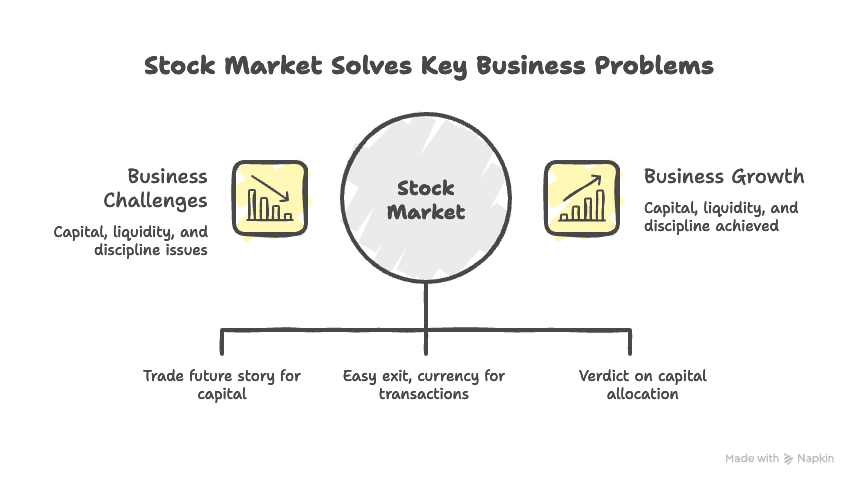
II. The Three Problems It Solves
Capital Formation. The stock market allows a company to take a story about the future and trade it for capital today at scale, from strangers, without giving up control to anyone. The price it gets represents the cost of equity: the rate at which all projects must be evaluated to have a material impact on the business. That’s why a SaaS company growing at 40% and making 20x revenue is the same price as a distributor growing at 1% and making 1x revenue. The stock market isn’t crazy. It’s just applying different cost of capital based on its own compounding potential.
Liquidity and Optionality. Why do people accept lower expected returns on publicly traded companies versus private companies? It’s because they can exit without going through a six-month process. It’s also why the stock market works as a currency: to buy companies, to keep employees happy anywhere in the world, and ultimately for your own balance sheet that you've been putting off.
Price Discovery and Discipline. Public company stock prices, over time, are a verdict on the allocation of capital. A company whose profits are below its cost of equity will experience a declining multiple, increasing cost of new capital, and an increasingly uneasy board. There is no analogue in non-public companies. It is a mechanism that links the boardroom and the ultimate cost of future boardroom decisions. It is frequently wrong in the short term. It is unforgiving in the long term.
---
III. Why It Doesn't Look Rational Up Close
The conventional wisdom holds that the price of a stock reflects the present value of future cash flows, discounted at an appropriate discount rate. It is correct. It is wrong in almost all cases. It is wrong because stock prices are not determined by formulas; they are determined by people, people who are motivated by fear, greed, and conformity. Behavioral finance has demonstrated the consequences of these forces:
- Loss aversion: the pain of losses exceeds the pleasure of gains, so people tend to hold on to losers and cut winners.
- Herding: new money flows are the result of price movements, not the cause. Momentum is an emotional response, not an intellectual one.
- Over- and under-reaction: markets overreact to extreme news, underreact to subtle news.
This is not an irrational market. It is not a rational market. It is something else: efficient, but only approximately, over time; systematically biased, but only over short time periods. It is a voting machine in the short term, a weighing machine in the long term, and a mirror in the time in between. And understanding that is worth more than any prediction.
---
IV. How This Shows Up in an Operator’s Life
On a Tuesday morning, you are not thinking about the stock market. You are thinking about a contract renewal date three weeks away, the site manager who handed in his notice, and the fuel costs this quarter to make sure you get the margin you have promised yourself you will get.
The stock market is not on your mind. And that is the problem.
You feel the market in three ways. And by the time you feel it, someone else has already made the decision.
You feel it one place as your exit. Your buyer, whomever they are, whenever they are starting a spreadsheet before they even think about your financials. And the multiple they use to calculate your financials comes directly from what the market is paying for similar businesses right now. You have not opted into this system. You have not opted out of it. Two operators have the same kind of service business. Same revenue. Same margin. Same customer base. One of them sold his business in Q1 2022. The other one sold his business in Q4 2022. The difference in the sale price was not operational. It was timing they could not control. It was a market they were not thinking about.
Second, the person you are about to lose. You made a promise to them: phantom equity, a share of the profits, a handshake about what a share of this thing might one day be worth. You meant it. They believed you. And deep down, they have been calculating what you promised them ever since not literally, not on a spreadsheet. But when they read about deals getting done in the industry, when they see what similar businesses are trading for, when the winds shift and the perceived value of what you promised them slowly starts to decline well, they are resigned to their fate before they even know it.
Third, the one no one wants to talk about candidly. You have spent fifteen years building something real. You have employees, you have customers, you have cash flow. And at some point along the way, without anyone ever telling you so, it became your pension, your safety net, your retirement plan, and your entire net worth all wrapped up into one package that you can’t sell on a Tuesday. No financial advisor would ever recommend such a concentration of risk to anyone except to call it an emergency.
---
V. How PlainStripes Designs Around It
The Three Bucket Operating System was designed because of the operator above—not the operator who goes public, but the operator who has twelve vans, two anchor accounts, and everything on the line.
Bucket One—Stability has no market risk. Six months of salary is the rule of thumb for a salaried employee. Six months of salary is not the rule of thumb for an operator whose salary is housed within the same entity as their risk. The business has a bad quarter; the salary does not hold. The contract does not perform; the salary does not hold. Bucket One is what holds. Volatility is not a tradeoff for an operator; volatility is not permitted.
Bucket Two—Strategic Growth takes market prices and turns them into operating intelligence. When multipliers are rising in your industry, that tells you something: that means that capital is cheap and demand is strong, invest in the business. When they are falling, it tells you something else. You don't need to monitor the ticker every day of your life. You need to monitor the thermometer once a quarter, and you need to monitor how hard you're pressing on the accelerator. Most operators are already doing this intuitively. The difference is doing it intentionally, using a number, before the market forces you to do it.
Bucket Three—Long Term Wealth is the counterbalance, and for an SME owner, it is not optional, not aspirational, not something you do later. Your business is already doing the job of Bucket One, and your business is already doing the job of Bucket Two. Your business is illiquid. Your business is operationally dependent on you showing up every day. Your business cannot be rebalanced. Your business cannot be trimmed if you have a bad day. Bucket Three is the only part of your financial life that compounds without your participation, that compounds without your input, that continues to work for you even if you get sick. Every year that it doesn't exist is a year of compounding that you're not going to get back.
Three principles govern it:
- Broad exposure over stock picking. You do not have to be right on individual securities. You just have to be in the market long enough for the market to work. The data on index-based compounding over twenty-year time frames is quite strong. The data on consistent after-fee alpha in active security selection is not.
- Drawdowns are accepted; design for sleep. Bucket Three will decline by thirty percent at some point. This is not a risk that needs to be managed. It is a requirement that needs to be designed for. The question is whether or not that decline, when it occurs, causes a mistake in one of the other buckets: a panic sale, a liquidity event, a decision made in a moment of stress that undermines all the work that has gone into the previous years of patience. Design is before drawdown. It is not after.
- Compounding tool, not scoreboard. The person whose job it is to check Bucket Three against the index every morning is not investing. He or she is creating noise that affects every other decision that person will make that day. Set it. Leave it. Let it do the one thing your business, for all its greatness, cannot do without you.
The Real Answer to "What's the Big Deal?"
The big deal isn't that the stock market goes up over time – although, as an aside, it does.
The big deal is that it is the official record of what the world currently believes about the future of businesses. It is the price at which risk is set, and stories are funded. It is the invisible force that affects operators in terms of valuation, talent, and wealth in ways that don't require your permission.
The work we do at PlainStripes is to make sure you understand this well enough to do three things:
Not be intimidated by it.
Not be reckless with it.
And not be oblivious to it when it starts pricing the very thing you've spent your life creating.
---
This letter is part of an ongoing series on capital, behavior, and operating with clarity. The previous letter explained the Three Bucket Operating System. The next letter will dig deeper on Bucket Three and how to create a compounding machine that works while you are busy operating the business.